|
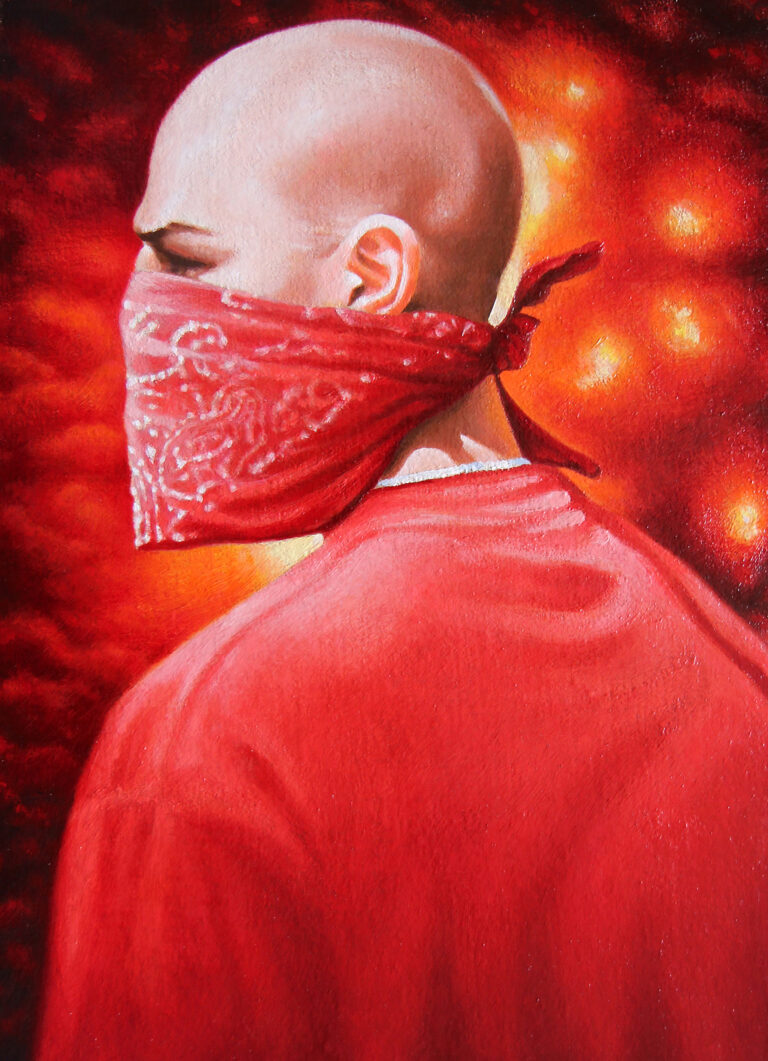
I prepared the masonite with several coats of acrylic gesso (covering the backside as well to prevent warping). I made a pencil drawing directly on the panel when it was dry, the sketch being a simple guideline for the painting to follow. I then mixed a tiny amount of burnt sienna oil paint with turpentine to create a highly transparent wash. Using a sable brush I laid down multiple applications of the wash to give form and depth to the subject and to distribute the lights and darks of the composition. When the monochromatic underpainting was dry I switched to bristle brushes and began to introduce color. I chose a limited palette of flake white, terre verte, Chinese vermilion, and a few select browns. I used only a tiny amount of stand oil mixed with turpentine as my painting medium. I mixed all of my paint on a glass palette (a flat sheet of thick glass), which I prefer over the traditional wooden artist's palette. The colors were mixed to my liking before being applied.
Adhering
to the rules of classical oil painting, each proceeding layer
of paint had a bit more stand oil in it, making the newer layers
"fat" as opposed to the underlining "thin"
applications of paint (this is important in preventing an oil
painting from cracking with age as it dries). I worked with a
variety of different sized bristle brushes, with quite large brushes
filling in fields of color and smaller ones for the details of
the ear, bandage, etc. I worked "wet on wet", that is,
I applied wet paint of one color directly into a wet area of another
color. However, at the end of a work session, I'd allow the painting
to dry to the touch for a day before beginning the next round
of work. Towards the end, each brush stroke was loaded with paint,
as I was aiming at a painterly effect with lots of heavy brushstrokes.
Living in the warm climate of Los Angeles, oil paint dries quickly.
When the surface was completely dry I gave the painting a coat
of clear retouch varnish to bring out the luster and brilliance
of the oil paint. Such a coating also protects the surface of
the painting. When the artwork is bone dry after a year's time
I'll give it a final coat of varnish."
If you are interested in aquiring this painting, please e-mail
for price and shipping details. |